
Mary is one of my favorite people in the Bible. I was recently asked to teach a lesson for my church’s women’s group, and so I focused on Mary and her preparation for the birth of Jesus from Luke 1:26-56. I wanted to write about some of the things I shared here.
First, we learn that Mary is “a virgin betrothed to a man whose name was Joseph” (v. 27) and she was from “a city of Galilee named Nazareth” (v. 26). When the angel Gabriel appears to her, he twice describes her as favored (vs. 28 & 30). It strikes me that Mary has done absolutely nothing to earn this favor. She is a nobody young Jewish girl who is pulled out of obscurity to become the mother of the Savior of the world simply because God chose her to be such. As another nobody, this gives me hope that God doesn’t need me to do something huge to get His attention. He sees, and wants to use, the lowly.
Because of God’s amazing grace, the same two things that the angel uses in his greeting to Mary (v. 28) can also be said about us as believers. First, he tells her she is “favored,” and according to Ephesians 1:6, we have been blessed with “his glorious grace” (the words for favor and grace here are the same). The angel then tells Mary, “the Lord is with you.” In Matthew 28:20, before his ascension into heaven, Jesus promises “I am with you always, to the end of the age.” This promise was given directly to his disciples, but is also for us as his disciples, too.
Next, the angel describes this promised child to Mary. He tells her to call him “Jesus” (v. 31), and that “he will be great and will be called the Son of the Most High” (v. 32). The angel then describes how Jesus will fulfill the Davidic covenant from 2 Samuel 7, by telling Mary he would receive “the throne of his father David” (v. 32), “he will reign over the house of Jacob forever” (v. 33), and there would be no end to his kingdom (v. 33). Mary got to know all of this about her son before he was even conceived, how awesome is that!
Speaking of his conception, that is the one question Mary has, which we might all be asking in a similar circumstance: “How?” (v. 34). The angel tells her it will be through the Holy Spirit, and that “the power of the Most High will overshadow you” (v. 35, emphasis mine). The word overshadow means to cover with a cloud. In the Old Testament, when the people of Israel were exiting Egypt, the presence of God went before them in a pillar of fire by night and a pillar of cloud by day. This cloud was a physical manifestation of the glory or presence of God. Later in the book of Luke, in the story of the transfiguration, Luke uses this same word to describe God’s presence on the mountain: “As he was saying these things, a cloud came and overshadowed them, and they were afraid as they entered the cloud. And a voice came out of the cloud, saying, ‘This is my Son, my Chosen One; listen to him!’” (Luke 9:34-35, emphasis mine). We can only imagine what this experience must have been like for Mary, but we can use these other passages to build part of a picture.
Also in answer to her question of how, the angel tells her about her relative Elizabeth’s pregnancy. Elizabeth is described as old and barren (v. 36), and yet the angel tells Mary she is six months pregnant. Elizabeth’s conception was miraculous, but still natural. She got together with her husband the way married people do, and the Lord opened her womb. I call it 50/50: 50% miracle, 50% natural. Mary’s conception, however, was to bee 100% miracle. God did a miracle so that Elizabeth could birth the messenger that would proceed His Son, but the Son of God was to get an even bigger miracle of a birth.
The angel then delivers his “mic drop” line: “For nothing will be impossible with God” (v. 37). This is actually a quote from the Greek version of the Old Testament, the Septuagint. In Genesis 18:14, the Lord says this to Abraham after announcing the miraculous birth he and Sarah will experience. He wanted Abraham, and now Mary, to know that He is omnipotent (all-powerful). He will do what He has said. And I believe He wants us to know that as well. That is one reason these stories are recorded for us, to develop our trust in God, and see that the same way He kept His word in the past, He will keep it in the future.
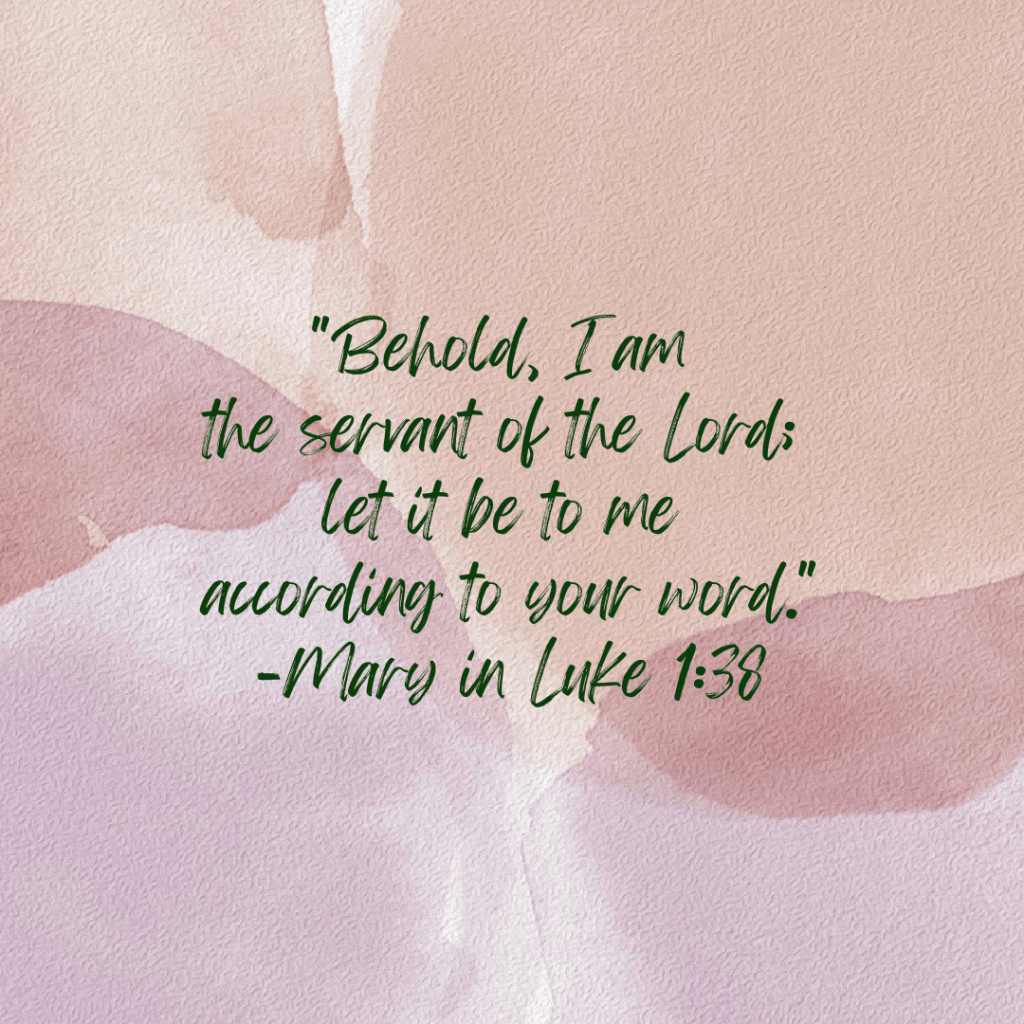
Finally, Mary responds with my favorite line from this story: “Behold, I am the servant of the Lord; let it be to me according to your word” (v. 38). Mary, knowing the shame that would surround a pregnancy out of wedlock, willingly submits herself to God’s plan. She humbles herself by calling herself a servant, and makes herself obedient to God. But in this statement I also see her confident trust in God, that He would work it all out. I’m sure she had a plan for her life that did not include this “interruption.” She was going to marry Joseph, have 2.5 kids and a donkey, and be the dutiful Jewish wife. But she was willing to pivot her plan because of the word the angel brought from the Lord.
Can we do the same? Can we let our desires, plans, and actions be guided by the Word of God? Like Mary, we should hold everything loosely, with an open hand, ready to say yes to God in whatever He asks of us, without any excuses. I want to encourage you, as you are preparing for Christmas, to prepare your heart attitude as well. If there’s something God is asking you to trust and obey Him in, say yes without excuse. Like Mary, make yourself a servant of the Lord.
Part 2 of this story next week!


 Alexa Bailey
Leave a reply to Rhonda Jean Jackson Cancel reply