
1 John is a beautiful letter (or some might say sermon) from the apostle John to the churches in Asia Minor. These believers were being enticed by false teaching, but he speaks with authority and affection the truths he learned from Jesus, encouraging the people to stand firm in the truth and not be led astray.
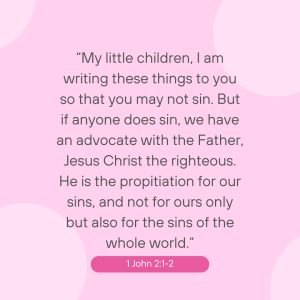
Right here John lays out his purpose for writing: “so that you may not sin.” But in 1 John 1:8, he said: “If we say we have no sin, we deceive ourselves, and the truth is not in us.” Remember these are believers John is writing to, and he has just told them they are going to sin. Hopefully only occasionally, but still, sin is going to happen even in the life of the Christian. What does 1 John 1:9 say? “If we confess our sins, he is faithful and just to forgive us our sins and to cleanse us from all unrighteousness.”
Jesus is always there to forgive us when we confess our sin. But John’s point is that this does not give us license to sin. As Paul says at the beginning of Romans 6: “Are we to continue in sin that grace may abound? By no means! How can we who died to sin still live in it?” John is not here to condone sin or make excuses for it. He is here to say we should do everything possible to avoid sin. As believers, we have everything we could ever need to get victory over sin. 1 Peter 1:3 tells us “His divine power has given us everything required for life and godliness through the knowledge of Him who called us by His own glory and goodness.” If you need a reminder of everything that is yours in Christ, read Ephesians 1. Being a Christian means our sin should bother us.
But again, when we do sin, because we are fallen humans and we will, the good news is that we have a righteous advocate. This word “advocate” means “one called in for or summoned as support; one who speaks in favor of another.” I love to watch crime shows, so I picture a courtroom here. You’ve got the judge, which is God the Father, and we stand before him as the defendants, guilty of every charge brought against us. But we have an advocate who speaks for us in the court room, our defense attorney Jesus. But instead of saying, “She’s innocent!” to our surprise, Jesus says, “You’re right, she’s guilty. She deserves the death penalty. But I stand in her place, entering my plea of not guilty on her behalf.” And as the only one to have lived a life without sin and therefore truly able to enter a not guilty plea before an omniscient judge, Jesus’ plea is accepted. The judge declares Him guilty, rather than us, and the penalty of death is paid in full by Jesus. The sinless lamb of God paid the death penalty for our crimes 2000 years ago so that we can live free and forgiven today.
Not only do we have this advocate who comes alongside us, according to verse 2 Jesus is also “the propitiation for our sins.” The word propitiation is not a common word. Other versions translate it atoning sacrifice, but it means “a sacrifice that bears God’s wrath to the end and in doing so changes God’s wrath toward us into favor.” Our sins deserve punishment, the full force of God’s wrath, but as one commentator put it, “Jesus’ sacrifice provided the payment to satisfy heaven’s justice. With God’s wrath satisfied, the sacrifice of Jesus is said to ‘propitiate’ or restore favor with God.”
In this one verse, John sums up his whole gospel, pointing to the righteous life Jesus lived, the atoning death he suffered, and his current work at the right hand of the Father in heaven. And the amazing thing is God propitiates, or sacrifices, himself! God is perfectly just, and if “the wages of sin is death,” that debt must be paid. But God is also perfect love, and in that love he satisfied the payment. There is absolutely nothing we can do, no amount of good works we can perform, to satisfy the wrath of God caused by our sins.
Praise Jesus for giving himself as the only sacrifice that could pay for the damage we’ve caused with our sins. He has broken down the wall that keeps us from right relationship with God. He has made forgiveness possible, while maintaining God’s righteousness. And he justifies us by declaring us covered with his righteousness before the Father.
 Alexa Bailey
Leave a comment