
I know what you’re probably thinking. “Easter was over a month ago. Why this post now?” Well, it was 40 days ago, to be exact, and 40 days after Jesus rose from the dead, something important happened that doesn’t get a lot of air time when we summarize the gospel.
If I asked you to summarize the life of Jesus, what would you say? Something along the lines of him being born as a baby, living a perfect sinless life, dying for our sins, and rising from the dead? But what about after that? How much time do you spend thinking or talking about the ascension?
That’s what I mean by the forgotten part of the Easter story. 40 days after the resurrection was the ascension, and it is essential to our faith.
What is the ascension? Luke ends his gospel this way, “And he led them [the disciples] out as far as Bethany, and lifting up his hands he blessed them. While he blessed them, he parted from them and was carried up into heaven. And they worshiped him and returned to Jerusalem with great joy, and were continually in the temple blessing God” (Luke 24:50-53).
Luke begins his next book with this same story, just a little more detail. Acts chapter 1 begins, “In the first book, O Theophilus, I have dealt with all that Jesus began to do and teach, until the day when he was taken up, after he had given commands through the Holy Spirit to the apostles whom he had chosen. He presented himself alive to them after his suffering by many proofs, appearing to them during forty days and speaking about the kingdom of God.
And while staying with them he ordered them not to depart from Jerusalem, but to wait for the promise of the Father, which, he said, ‘you heard from me; for John baptized with water, but you will be baptized with the Holy Spirit not many days from now.
So when they had come together, they asked him, ‘Lord, will you at this time restore the kingdom to Israel?’ He said to them, ‘It is not for you to know times or seasons that the Father has fixed by his own authority. But you will receive power when the Holy Spirit has come upon you, and you will be my witnesses in Jerusalem and in all Judea and Samaria, and to the end of the earth.’ And when he had said these things, as they were looking on, he was lifted up, and a cloud took him out of their sight. And while they were gazing into heaven as he went, behold, two men stood by them in white robes, and said, ‘Men of Galilee, why do you stand looking into heaven? This Jesus, who was taken up from you into heaven, will come in the same way as you saw him go into heaven’” (v. 1-11).
So, what is the ascension? Jesus’ return to the Father, not through death, but by ascending in glory. His disciples watched him literally, bodily, return to heaven until a cloud obscured their line of sight. Then two angels were sent to confirm where Jesus now sits “at the right hand of God, with angels, authorities, and powers having been subjected to him” (1 Peter 3:22). Mark puts it this way at the end of his gospel: “So then the Lord Jesus, after he had spoken to them, was taken up into heaven and sat down at the right hand of God” (Mark 16:19).
Why is this important? There are several reasons:
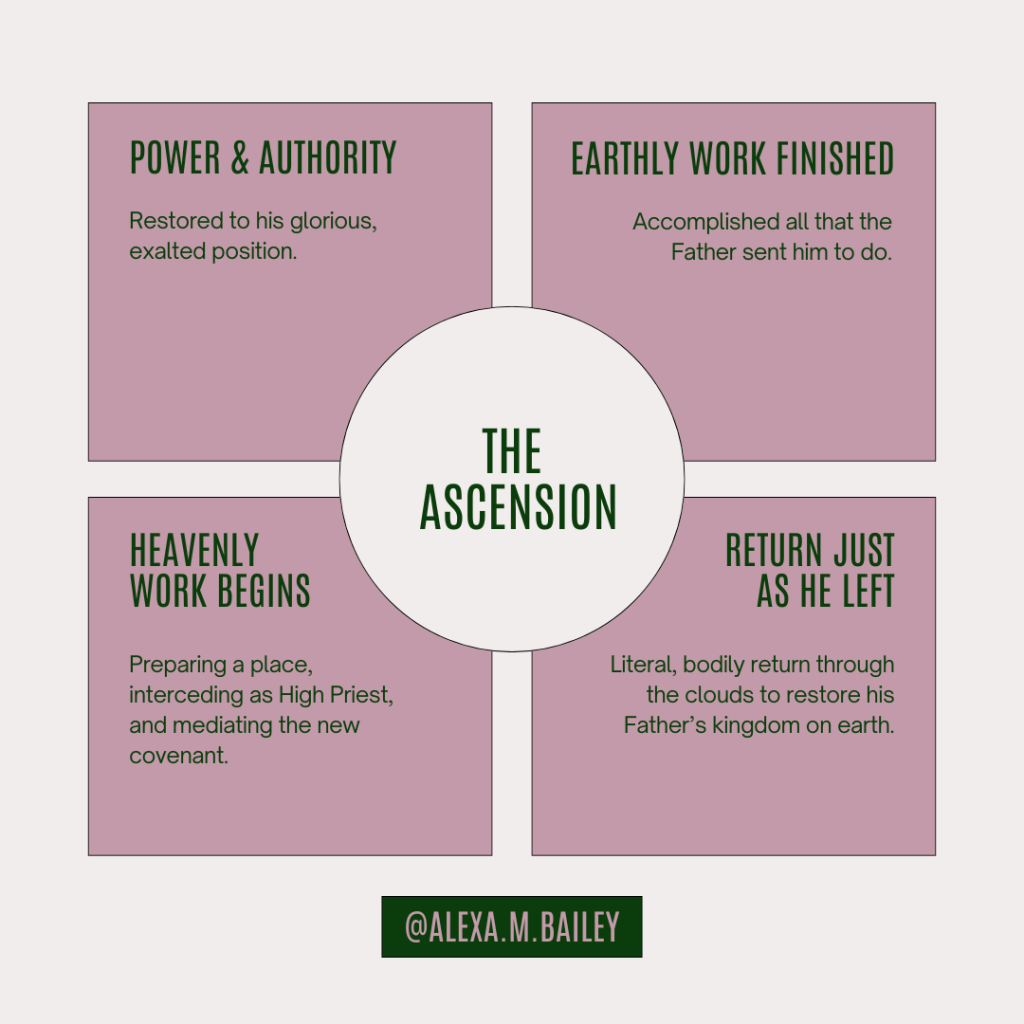
- The right hand is a place of power and authority. Jesus being at the Father’s right hand means He has been restored to His glorious, exalted position. The glory of the Son that was veiled in his earthly body can now shine in its fullness as he takes his rightful place of honor. (See Ephesians 1:20-23 & Philippians 2:8-11.)
- His being seated means his earthly work is finished. He had done all that the Father sent him to do, so He could now return to the Father with a successful mission accomplished. (See John 19:30.)
- Now his heavenly work begins. Jesus is preparing a place for us, interceding for us as our High Priest, and mediating the new covenant. (See John 14:2, Hebrews 4:14-16, 7:25, 8:1 & 9:15.)
- He will one day return just as he left: a literal, bodily return through the clouds to restore his Father’s kingdom on earth. (See Daniel 7:13-14, Matthew 24:30, & Revelation 1:7).
So we celebrate the ascension as a part of Christ’s story as we watch and wait for His return to make all things right and new.
 Alexa Bailey
Leave a comment