
Matthew begins his telling of the Christmas story with a genealogy that most people probably skip right over. He starts with a summary: “The book of the genealogy of Jesus Christ, the son of David, the son of Abraham” (Matthew 1:1). The family line was traced through the males, but for us ladies, I want to substitute the mothers’ names into this verse: “The book of the genealogy of Jesus Christ, the son of Bathsheba, the son of Sarah.”
Sarah was the wife of Abraham, and back in Genesis 12 this couple was chosen and called by God to be a blessing to the nations. God appeared to Abraham five different times and repeated his promises to Abraham, but it is not until chapter 17 that God includes Sarah by name in these promises. God shows up thirteen years after Abraham and Sarah have taken matters into their own hands and used a servant Hagar to produce a child, and the first thing He says is, “I am God Almighty; walk before me and be blameless, that I may make my covenant between me and you, and may multiply you greatly” (Gen. 17:1b-2). It is here Abraham gets his name changed from Abram and is given the covenant of circumcision.
And then God turns His attention to Sarah and says, “As for Sarai your wife, you shall not call her name Sarai, but Sarah shall be her name. I will bless her, and moreover, I will give you a son by her. I will bless her, and she shall become nations; kings of peoples shall come from her” (Gen. 17:15b-16).
So Sarah is to play a crucial role in this family, as well she should since she is Abraham’s wife. But one chapter over, when God comes again and tells Abraham the timeline for this promised offspring, we find Sarah listening at the door of the tent. Sarah’s response to having a son at ninety years old is recorded in Genesis 18:12: “So Sarah laughed to herself, saying, ‘After I am worn out, and my lord is old, shall I have pleasure?’ ”
Now let’s fast forward the story to Luke chapter 1, where another woman gets another revelation about another promised offspring. This story we are probably more familiar with, how God sent the angel Gabriel to a virgin named Mary, who tells her in Luke 1:31-33, “And behold, you will conceive in your womb and bear a son, and you shall call his name Jesus. He will be great and will be called the Son of the Most High. And the Lord God will give to him the throne of his father David, and he will reign over the house of Jacob forever, and of his kingdom there will be no end.”
Another surprising announcement about the coming birth of a son, and Mary, like Sarah, responds with a question: “How will this be, since I am a virgin” (Luke 1:34)? But unlike Sarah, there is no doubting laughter, only genuine curiosity.
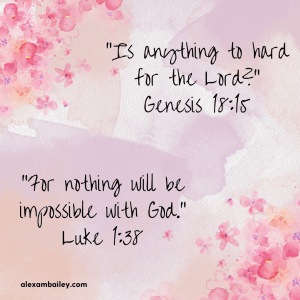
Now I want to narrow in on God’s response to these two women’s questions. When Sarah questions God, He responds, “Is anything too hard for the Lord” (Gen. 18:14)? When Mary asks her question to the angel, he responds, “For nothing will be impossible with God” (Luke 1:37). In our English translations, these questions may not look the same, but in Greek the statement in Luke is actually a quote from Genesis 18:14 in the Septuagint (Greek Old Testament).
Two women. Two miraculous births. Two responses to God’s announcement. Both met with one response by the unchanging God who has been working out this plan from the beginning of time. And although Sarah responds to God with backpedaling and denial of her laughter (Gen. 18:15), and Mary responds with humble trust (Luke 1:38), God still uses both of them.
If we were to continue in the genealogy Matthew gives us, we would see “Abraham [Sarah] was the father of Isaac, and Isaac the father of Jacob, and Jacob the father of Judah and his brothers, … and Jacob the father of Joseph the husband of Mary, of whom Jesus was born, who is called Christ” (Matt. 1:2, 16). Sarah may not be recorded by name in this genealogy, but she and Mary form the bookends that begin and end this epic family line that would lead to the ultimate promised offspring, King Jesus.
I pray the stories of these women remind you, when you are met with a seemingly impossible situation, you can ask yourself, “Is anything to hard for the Lord?” and remember the answer, “For nothing will be impossible with God” (Gen. 18:15; Luke 1:38).
 Alexa Bailey
Leave a comment