
In Matthew 22:37, when asked about the greatest commandment, Jesus said, “You shall love the Lord your God with all your heart and with all your soul and with all your mind” (emphasis mine). Studying the Bible, with the goal of getting to know God better, is one of the best ways to love Him with your mind. I want to share with you my process for studying a book of the Bible, as well as link some resources I love and have found super helpful. (Anything in bold is linked!)
First off, the ESV Study Bible is by far my favorite Bible to use for study. I also gather my notebook, pens, and highlighters. (I like using a bunch of colors, because Bible study can also be pretty! Also, I use different colors for different parts of study, and it helps me recognize note categories at a glance when I go back. If color-coordinating your notes is not your thing, totally fine!)
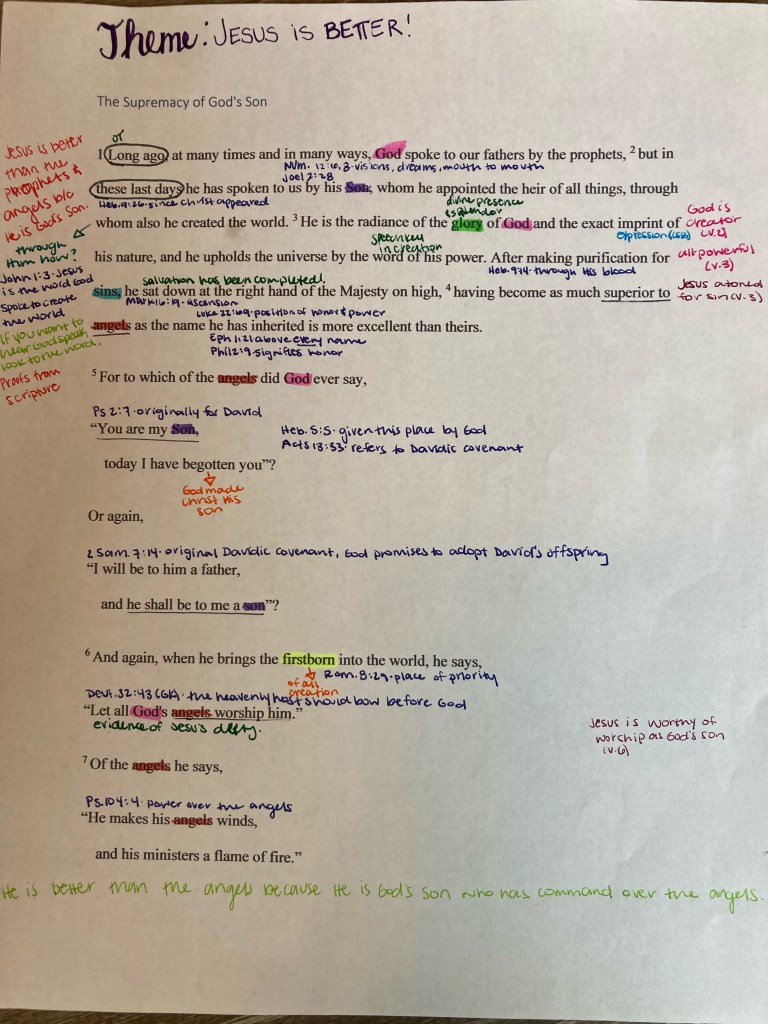
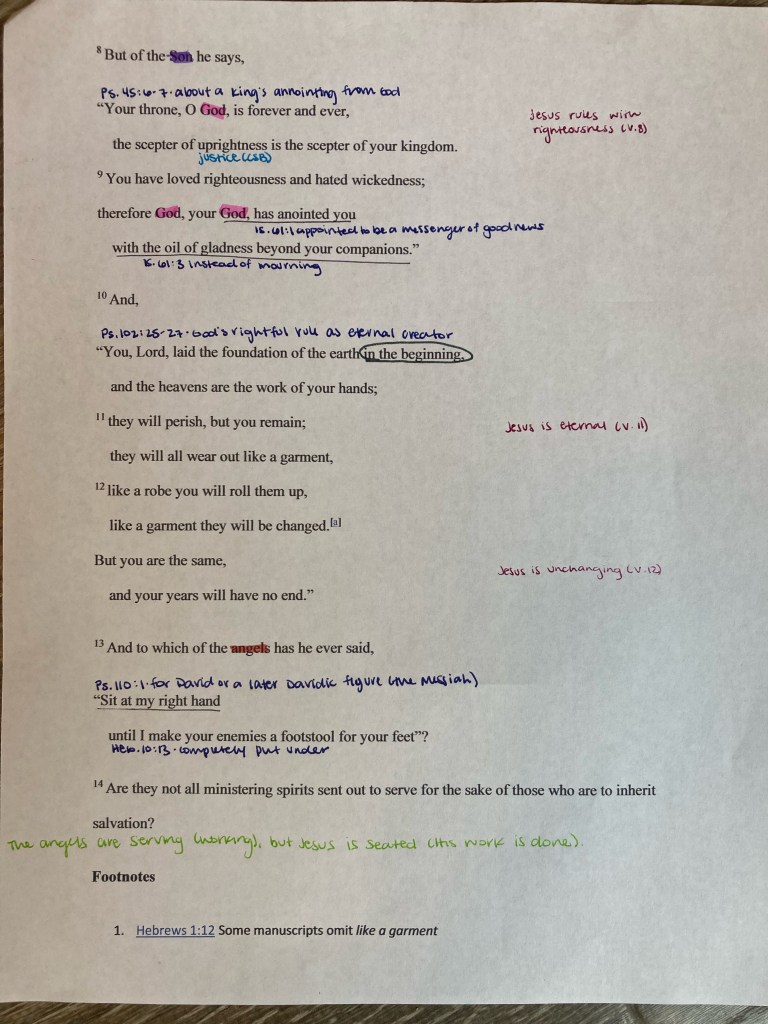
At the end of this post, I have shared an example of my notes on Hebrews chapter 1. Throughout this post, I will reference the color pen I used for my notes in each section (example: the red is my summary).
With these basics, you’re ready to start. I always begin my Bible study time with prayer, inviting the Holy Spirit to help me see God accurately through the Scripture I’m about to read. Without Him, I will just be reading words on a page. He is the one who can help me understand what I am reading, more than any study note, commentary, or other resource I use.
Once I have decided on a book of the Bible to study, I gather some background information that will help me better understand the original intent of the book within the context it was written. Does the Bible apply to us today? Absolutely, but we must always remember that each book was written during a real time in history to real people, so to rightly apply it to ourselves we must first see how it applied to them. A study Bible will generally have the answers to the following questions in the book’s introductory material:
- Who wrote the book?
- To whom was it written?
- When was it written? (If it was written after the events the book records takes place, I will also try to find a time period those events as well to give me a better idea of the circumstances for those receiving the book.)
- Where was it written?
- What genre is the book?
You may now feel like you’re back in a high school English class, but knowing the genre of the book you’re reading is so important if you’re to understand it correctly. A narrative account of the life of David, for example, is not meant to be read the same way one of his poems is. But that’s another blog post!
The ESV Study Bible has some great maps, so for those of us who would say geography is not our strong suit (read: me), looking up where a book was written, or where the events take place is really helpful. Another (free!) resource I have found helpful when gathering background material is this Outline of Biblical History. I have this PDF printed and folded into my Bible because (spoiler alert!) the Bible is not arranged chronologically, and I can get lost in trying to remember all the dates, so this page gives me a quick snapshot of where I’m reading in the history of the Bible.
So now that I have the background info for the book, I start by reading the whole book, without looking at any of the study notes or commentary. I don’t really take notes at this point, because I’m just trying to get a feel for the book as a whole. The only thing I might do during this read through is underline repeated themes that I notice (underlined in black in my example below). After reading through the whole book (sometimes more than once if it’s a book I’m not super familiar with), I’m ready to dive deeper.
I start by putting the first chapter or section of the book into a double-spaced word document so I have plenty of room for note taking (just copy and paste from biblegateway.com). Then I read that chapter all the way through, multiple times, until I can summarize each section (red in my example below). Doing this helps me remember the main ideas of the passage. I will also highlight any repeated key words, people, and places (and look for them on the map!). These lists will also help you notice words that are key throughout the whole book, even if they’re not repeated in the particular section you’re currently studying. If any of the words are confusing, look them up (orange in my example below)! I also like to read the chapter in another translation (the Bible app is really helpful for this) and write in alternative translations for words that might aid my understanding (light blue in my example below). When studying in the gospels, I use A Harmony of the Gospels, which puts the same stories told in multiple gospels side by side for easy comparison.
Then I list out to the side any attributes of God or references to Jesus and His work from the chapter (pink and purplish in my example below). This is a CRUCIAL step because we are reading to know God first and foremost, so I take my time on this section, usually praying and thanking God for who He is and how He has revealed Himself at the same time.
Then I usually jot down any questions that I have about the text (teal in my example below). I take some time to sit with these questions and ask the Holy Spirit (again) to help me understand what I’m reading before I ever go looking for someone else’s answer to the questions. One principle I have learned recently that has helped is to let Scripture interpret Scripture. The middle of the ESV Study Bible is chock full of cross references that will help you do just that. While time consuming, it has been so beneficial to my study to look each one of these up and note any helpful connections (dark blue in my example below). Nine times out of ten, one of the cross-referenced Scriptures has helped answer the questions I wrote down.
After doing all this and letting it soak in, I will write in some of my thought/comments/things I’ve learned (lime green in my example below). Only then will I turn to the study notes in my Bible and some commentaries to see what people with more degrees than me have learned about the passage (dark green in my example below). Other than the notes from the ESV study Bible, I use the notes from the Faithlife Study Bible, Enduring Word commentary, and/or some of the commentaries from the Blue Letter Bible (all available as apps).
Once I have this full picture of the text, I’ll add to my journal everything I’ve learned about God, myself, and what I should do based on the chapter. This whole process does not happen in one sitting! I can spend about a week on one chapter, going through a few of the steps each day. The point is there is no rush. Take the time you need to really understand what you’re reading and meet with God. Anything you put in will come back to you.
I hope you found this helpful! See my Bible Study Tools Amazon List for resources linked throughout the blog. As an Amazon Associate I earn from qualifying purchases.
 Alexa Bailey
Leave a comment